Little Free Library: A Chicago (& Worldwide) Spotlight

Little Free Libraries excites me because they encourage reading and neighborhood interaction. If you follow this blog, then you know by now that those are two things for which I’ve already demonstrated a lot of enthusiasm (here and here, for example).

A Little Free Library is very simply a free book exchange. Though they are connected through a nonprofit organization, it appears anyone can start one. For that reason, there are now more than 40,000 registered Free Little Libraries across all 50 states and in more than 70 countries worldwide. So if you’re thinking these little boxes look familiar, it’s probably because you have one near you.

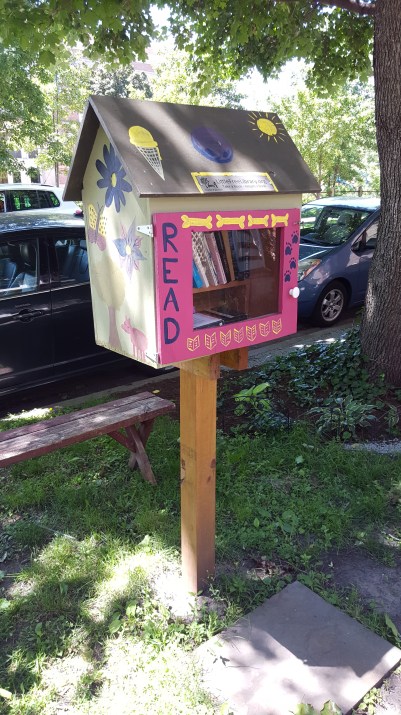
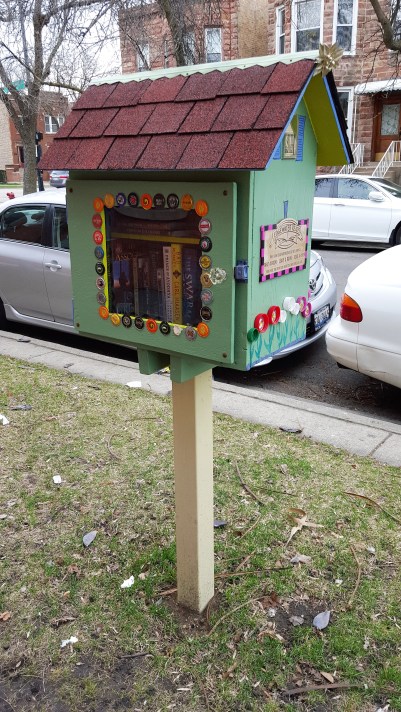
The first little box I encountered (near First Slice on Ashland, one of my favorite local bakeries) piqued my interest, especially because it was so carefully decorated. Upon further inspection, I realized it’s actually affiliated with Edgewater Reads, but tomato, tomato (which really loses its pizzazz when written).

20160330_162953

Love at first sight at Ashland and Balmoral.

It soon became my goal to find as many of these libraries as I could. Not necessarily to collect or donate books, but rather to take in a little bit of the blocks and neighborhoods they represented.

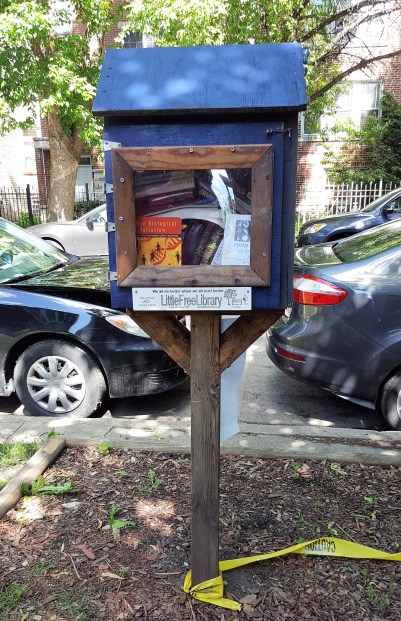
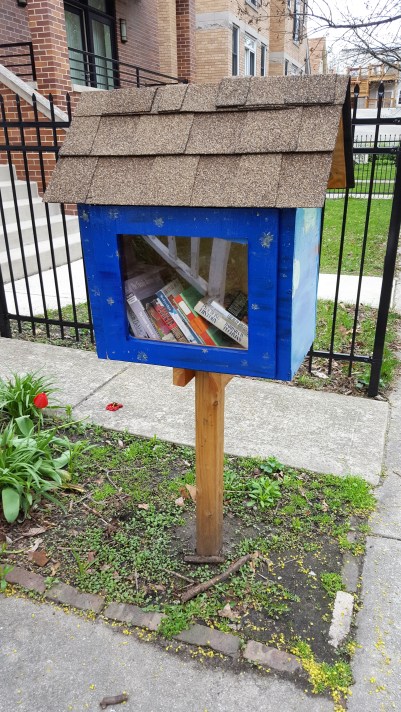
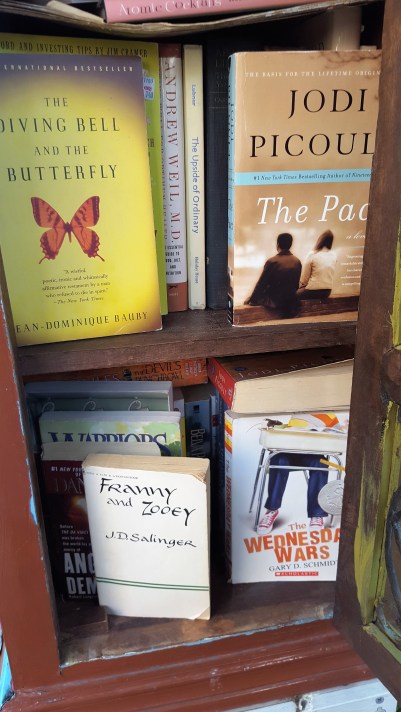
Here are a few of my favorites from the Andersonville, Ravenswood Gardens, and Lincoln Square areas.

20160608_140154

Campbell and Sunnyside.

20160605_153148

Rockwell and Leland.
20160426_102544
I cannot remember the location of this one. Oops!

20160407_141457

Glenwood and Berwyn (woo, Andersonville and Sweden!).

Finally, after months of casually (and a little creepily) taking pictures, I decided it was high time donate. So one day, Papa Bear, Baby Bear, and I all went for a little stroll over to the Little Free Library on Eastwood near Rockwell. I love Ravenswood Gardens, so I was happy to leave a little piece of me behind.

20160605_153704

Donation target at Rockwell and Eastwood.

20160605_151420

Our contribution.

20160605_153602

Adiós, friends.

Plan Your Visit

Check out this map to find a Free Little Library near you. If you can’t, start one!

Postpartum Periods, And I’m Not Talking About the “Fourth Trimester”

Consider this your official warning. If you don’t want to hear about periods–and just to clarify if you didn’t get the hint in the title, I’m talking about menstruation here–you should probably stop reading this post.

It is partly a motherhood blog, after all, and if you learned anything from your elementary school “birds and the bees” conversation, you should know that a period is a part of the whole deal.

Dad, I’m giving you a fair warning.

Are they gone? Okay. Let’s get started.

Postpartum Periods: Revenge of the Menses

anigif_enhanced-buzz-29180-1410743813-6

At this point, I should probably dedicate my blog to The Shining. It’s so diverse in its relevancy!
[Source]

My first post-baby period came when Baby Brown Bear was eight months old. Even though I had been wondering when it would happen, even (stupidly) wanting it to come back, it was still a bit of a shock when it actually did. And at eight months, I recognize that I’m pretty lucky! Some moms get theirs back within weeks (and subsequently flip Mother Nature the biggest bird they can muster). As if you don’t have enough bleeding and trauma down there already. I mean, come on.

I have enough friends with babies that I knew that my period might be a little different or that it would suck having it again after nearly 18 months, but I just wasn’t prepared. Why is it that, you might ask? Well…

I’d Forgotten Some Things

Like buying supplies

When you don’t have a period for 17 months, it’s easy to lose track of buying things like tampons. When my period first started, and it came back roaring, I had to desperately rummage through all of our bathroom cabinets. After searching to the point of sweating, I finally discovered a lone, half-empty box of regular absorbency tampons and a handful of postpartum hospital pads. You know, the kind that are basically little pillow-sized adult diapers. I first tried the tampon, but let’s be real, it was like trying to plug a tailpipe with a toothpick. I suppose I’m lucky I had those diapers, because they really work. Pro tip: ask for a bunch of extras when you leave the hospital because you may need them when you forget to buy supplies several months down the road.

Like how hungry I get

Right after baby came, and while my hormonal body was adjusting to milk production, I was ravenous. I must have craved a burger and shake every two hours. That hunger eventually tapered off, though I still feel like I go from zero to 1,000 on the hunger scale if I wait too long between meals, and I returned to eating just slightly more than the average person. Well, lo and behold, when that first period came back, it’s like I morphed into a lumberjack coming home after chopping 65 logs. For a girl who genuinely loves vegetables, all I wanted was cake and chocolate and butterscotch and ice cream and salt and vinegar chips and pickles. And a burger for good measure.

Like how emotional I am

Another throwback to the hormonal shifts immediately following birth, I just wasn’t ready for the emotional roller coaster that comes with a period.

tumblr_inline_mt32s57yq71s3m0x1

I’m sure my husband would have preferred I be locked up in a glass case.
[Source]

My sister-in-law said she knows she’s about to be on her period when she feels rage. It’s an appropriate description, really, because I seem to turn from a lovable but slightly irritable woman into a violent, prehistoric sea monster awakened and empowered by nuclear radiation. Otherwise known as Godzilla.

period-gif

This totally would have been me if I still had a job. Instead I had to resort to yelling at the dog. Baby Bear’s first words are destined to be, “No, Kaiser!” At full volume, nonetheless.
[Source]

Like the gas

Like many other bodily issues, I had to wonder at first if this was a result of pregnancy or if it was just a period symptom I had long forgotten. When Google told me I must have a life threatening illness, I turned to friends who put my mind at ease and kindly reminded me that being a woman can suck.

91u18

[Source]

Some Things Have Straight Up Changed

Like the fact that I’m feeding a human being

Baby Bear continues to eat more and more solids, but his primary food source is still breast milk. That means he’s attached to me for a good portion of the day. It also means that my body knows how much milk he typically needs in that day. Well, little did I know that period hormones can decrease milk production. I started to feel like I was starving my baby because I couldn’t rebound fast enough each time he wanted to eat. It frustrated him and it scared me. Plus, the taste can apparently change a little bit, which is yet another thing I didn’t realize could happen. Not only did I fear I wasn’t making enough, but half the time he would refuse me by dramatically gagging anytime I got near him. Thanks, Baby Bear. As if I didn’t feel bad enough already.

Like the unpredictability in its duration

Period, period, how it blows. When it stops, nobody knows.

I think I’ve made my point on this one.

82cc1d054ae48931b71339a061a55742

[Source]

Like the flow

Oh God, the flow. Having a baby turned my babbling brook of a period into a flood of damn near biblical proportions. Honestly it feels like I’m being punished for giving birth by having my body experience 17 months’ worth of periods all at once. Maybe time has helped me forget, but I seriously don’t remember ever being able to feel my period happen. On the positive side, I now know what I’d look like in a murder scene.

59868782

[Source]

Is It Just Me?

If that’s the case, then man that sucks. However I have a feeling some of you may know what I’m talking about here. I suppose we should all be grateful that our bodies are functioning as they are supposed to–and I really am OVER THE MOON that my body allowed me to carry, birth, and care for my baby–but I think it’s okay to bitch every now and again.

What am I missing? Were you taken aback when it came for you?


Mama Bear’s Labor & Delivery Resource Guide

Though Baby Bear is still only 10 months old, his first birthday is looming. Every time I see a pregnant woman, I feel like she and I are compatriots, both starting our motherhood journeys. Then I realize that baby months are like dog years and 10 months are practically a lifetime. I mentioned it in greater length already, but it really does feel like it’s just been a blink of an eye since he was born.

In starting to mentally prepare myself for what I know will be an emotional day (mostly for me, no doubt), I’ve been thinking a lot about my labor and delivery. Now that my hormones have regulated and I can reflect on those days with more clarity, I decided to put together a list of recommendations based on what helped me feel most prepared for the big day.

pexels-photo-57529

[Source]

Birth Wishes Disclaimer

I’d like to preface this guide by saying that this is a judge-free zone; this mama is supportive of whatever kind of birth is best for you. In fact, my motherhood mantra is “whatever works.”

Regardless of how you want to bring your baby into this world, I hope you feel supported and empowered. At the end of the day, what we all want is a healthy baby and a healthy mom.

That said, I do think it’s helpful to do a little research so you know what options are available to you, especially should any complications arise. If nothing else, this preparation helps you understand the various and acronym-heavy labor and delivery terminology. It also helps you and your partner think about what you value most in terms of your birth experience. Trust me, you won’t want to discuss your plans in throes of contractions.

I also think it’s helpful for you and your partner to document your birth wishes and discuss them with your provider and support team. The more educated and vocal you are about your wishes, the more prepared you will feel.

Understanding that I had to be flexible, it was my goal from the start to have a natural, un-medicated childbirth. While that is somewhat reflected below, I fully believe that the following suggestions are valuable to any expectant mom (and her partner).

Okay, disclaimer done. Let’s continue.

Labor & Delivery Prep Recommendations

Here are my suggestions for how you can achieve a positive birth experience.

1. Hire a doula

pexels-photo-89695

[Source]

A doula is a trained childbirth expert who provides emotional and physical support before, during, and after a baby’s arrival. I loved my midwives, as mentioned below, but I knew they probably wouldn’t be in the room with us the entire time. As first-time parents, both Papa Bear and I felt we could benefit from having someone with experience on hand throughout the entire labor to help guide me through contractions, advocate for us if we needed help understanding potential issues, and provide reinforcement for Papa Bear.

In addition to day-of support, our doula, Audrey, met with us during a few prenatal visits to discuss our birth wishes and go over exercises to help baby get into position, pain management techniques, breastfeeding, and what to expect with a newborn. These visits were also an opportunity for us to learn more about each other so we would feel more comfortable during labor (I knew she would see me naked, after all). She also visited us a few times after Baby Bear arrived to help with belly binding and breastfeeding.

Most importantly, Audrey was incredible during my labor. She played an integral role in helping me achieve a positive birth experience. Over the course of those 36 hours, Audrey traded back and hip press responsibilities with Papa Bear and took many turns pouring water over my belly in the tub. She also helped me find my voice when I was having complications delivering the placenta and everything turned into a fog. She was an incredible asset and I can’t recommend her enough.

If you choose to ignore every other item on this list, I hope you do yourself a favor and find a doula. DONA International is a great resource if you want to learn more about the benefits of birth doulas or would like to find one.

Chicago recommendation: Audrey (Thomas) Lava of Breathe Love Doula

2. Take a birth class

picnic

[Source]

There are a million varieties of birth classes available in any major city. At the suggestion of our midwives, Papa Bear and I attended a six-week course that focused on, among other topics, evidence-based practices, emotional health, and partner communication. We also took the recommended breastfeeding and bringing baby home follow-up classes.

The biggest benefit of a birth class is that it arms you with information about current protocol, including possible interventions, risks, and options, and helps you think about what you want out of your birth experience.

Another huge benefit is that it is great for your mental health. In a birth class, you are surrounded with other soon-to-be-parents who can relate to all the anxieties you feel about the huge change you are about to encounter. Plus, we ended up making two very good friends in the class, and that’s always a bonus!

Chicago recommendation: The Power of Birth class at Chicago Family Picnic

3. Use a midwifery group

pexels-photo

[Source]

Now, there are many reasons you may want or need to see an OB for your delivery, and that’s totally cool. My previous provider, whom I loved, was an OB. Seeing as how he’s about 80 years old, though, he wasn’t in the business of delivering babies anymore so I had to seek someone new. Luckily for me, there is a highly rated midwifery group right down the street from my apartment. After taking their tour, it was an easy decision to make the switch.

The midwifery model of care takes a holistic approach to women’s health and really centers itself around a woman’s emotional, physical, and social well-being. Generally speaking, midwives handle low-risk pregnancies and are known to have fewer medical interventions (including Cesarean births). Not only were these qualities attractive to me in hopes of having a natural birth, but I was also drawn to the idea of being treated more as a partner instead of a patient throughout my pregnancy and postpartum periods.

I also loved that the midwifery group practiced the latest in evidence-based care. In fact, their standard protocol was almost a perfect match with my birth wishes. I never felt judged or worried after my prenatal appointments, even when I was gaining more weight than expected and was freaking myself out. It was a beautiful relationship, and one I would wish for any woman.

Chicago recommendation: Midwifery Group at Swedish Covenant Hospital

4. Read Ina May’s Guide to Childbirth

ina may

[Source]

Okay, here’s where we get a little crunchy. Ina May Gaskin is arguably the most famous midwife in the country and was a founder of The Farm Midwifery Center, which is basically an out-of-hospital birth commune (I told you it was going to be crunchy). She says childbirth is something women are built to do and is a proponent for treating birth as the spiritual experience it was meant to be. Now, a lot of what she says should be read with a grain of salt, but she emphasizes positivity and that’s why her book resonated with me so much.

I also recommend this book because more than half of it is just different women telling their (positive) birth stories. Pregnancy literature is saturated with horror stories about what might go wrong and how hard labor is. Everyone knows things could go wrong and that labor is hard. Those books made me feel discouraged and like I was facing a mountain. Ina May’s book made me feel excited about the labor and delivery. It made me focus on the connection I had with my baby and think about the beauty of labor. It made me feel strong, powerful, and, well, womanly. Every woman should feel so empowered before she gives birth.

Book recommendation: Ina May’s Guide to Childbirth by Ina May Gaskin

5. Be active & exercise

healthy-person-woman-sport

[Source]

This is a no-brainer, but it bears repeating. At the risk of sounding overly emotional, I enjoyed exercise more while pregnant than I ever have because I couldn’t help but think about the physical connection baby and I shared. Each breath I took was for both of us; each movement I made could be felt by both of us. Though I hadn’t been a yogi before pregnancy, I will say that prenatal yoga was an especially good way to focus on this relationship.

It was also helpful for me to view exercise as training for the most difficult physical challenge I would ever face. Once I was out of the exhausting first trimester, I hit the ground running (well, more elliptical riding and walking). Staying active throughout my pregnancy helped me feel ready for the physicality of labor and definitely contributed to my being able to keep going after such a long time.

Chicago recommendations: Women’s Workout World (gym), Bloom Yoga (yoga), North Shore Channel Trail (walking path)

6. Make a kickass playlist

spotify

This is a small glimpse of my own labor playlist.

If your labor and delivery unit allows you to play music, I highly suggest grabbing a Bluetooth speaker, subscribing to Spotify (I have the Premium membership for $9.99/month), and putting together your own labor playlist.

Choose music that makes you feel inspired (“I Believe I Can Fly”), sentimental (“Can’t Help Falling In Love”), amused (“Beelzeboss (The Final Showdown)”), like an badass (“I’m Shipping Up to Boston”), happy (“Could You Be Loved”), relaxed (“Aloha Oe”), and like the powerful woman you are (“Run the World (Girls)”).

As you can see from the sample in the picture and my above recommendations, my playlist included quite a random collection from across nearly every category, from opera to disco to rap. Each song was carefully chosen to make me feel as pumped up as possible. For the most part, I had some kind of special memory tied to each song, which made for a nice little distraction during contractions. As labor progressed, I started paying less attention to the world around me (including the music), but one of my favorite labor memories was being in the birthing tub, having a very zen moment, and hearing the suddenly loud and…uh…vulgar words of “Down With the Sickness.” My nurse looked at me like I had two heads, but it made me laugh when I didn’t think it was possible. The only song I ended up telling Papa Bear I “just couldn’t listen to right now!” was “Tearin’ Up My Heart.” Sorry, *NSYNC. I was in a zone.

In Short

Feel free to take or leave the above recommendations; together they helped me feel excited and ready to welcome my baby, but everyone is different.

Again, the most important thing is that you feel supported and empowered throughout your pregnancy, labor, and delivery. You are birthing a human being into this world! No matter what, surround yourself with positivity. It’s a beautiful time in your life and should be celebrated as such.

Do you have any other suggestions? Please comment!
Unabridged Bookstore: A Chicago Spotlight

Yes, yes, yes. I’m a little late to the game, seeing as how it was voted as Chicago’s “Best New-Book Store” in 2015, but I finally made my way down to Lakeview’s Unabridged Bookstore to celebrate Independent Bookstore Day on April 30. (To clarify, “new-book store” refers to a shop where you can purchase new books instead of used books.)

Opened in 1980, it’s been a neighborhood–and city–staple for more than 35 years. Given how tumultuous the last decade has been for brick and mortar bookstores, it’s incredibly impressive how much this one thrives. If you’ll recall, I’m a huge proponent of shopping locally. For the most part, locally owned businesses just care more. They are more knowledgeable about their products and provide superior customer service than the typical big box (and certainly more than online shops). This holds especially true for Unabridged.

The staff was extremely helpful and patient. I was actually a little startled when one employee immediately recognized the titles of two rather obscure children’s books I was trying to find. Though he sadly informed me they were not in stock (which he knew without having to check), he quickly offered to order them for me. After I unsuccessfully searched for a third book, he walked me straight over to where it was hiding. It was a busy day and he didn’t need to do it, but he didn’t even bat an eye. Perhaps these things shouldn’t have impressed me as much as they did, but his sincere helpfulness seems extraordinary nowadays and I really appreciated it.

I was equally impressed with the size and variety of stock Unabridged has. I expected the store to be smaller given that it is located in a city where space is limited. Since one of my favorite pastimes is lackadaisically perusing bookstores, you can imagine my delight when I discovered I was wrong. I could have spent hours exploring all the genres and shelves Unabridged carefully curates. Since I had a hungry baby at home, my first Unabridged adventure was unfortunately cut short. However, I think it was the beginning of a beautiful friendship.

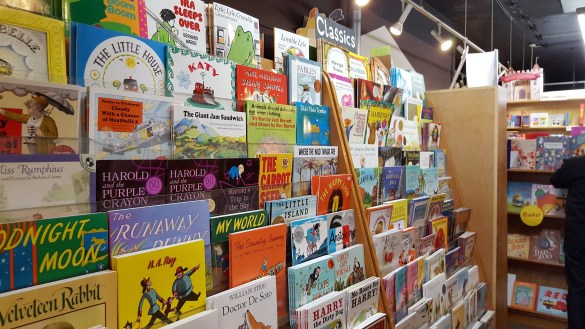
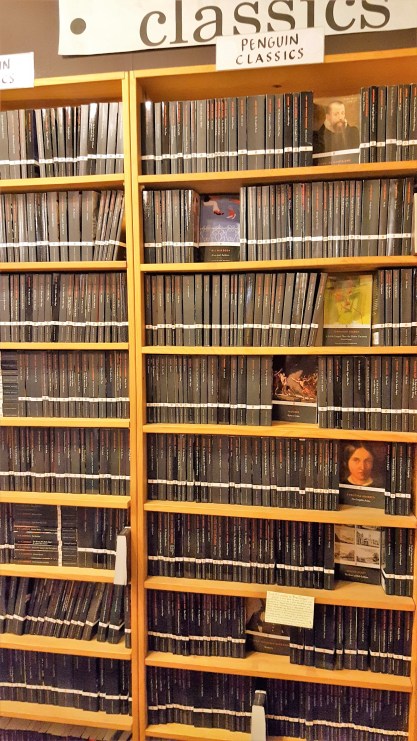
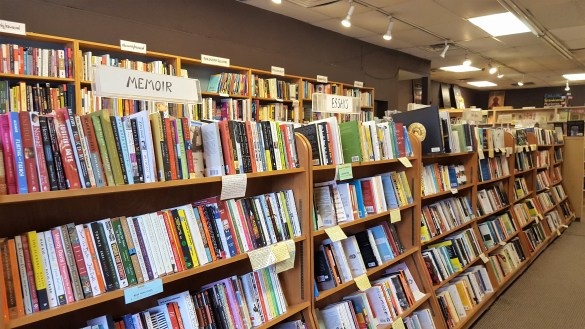
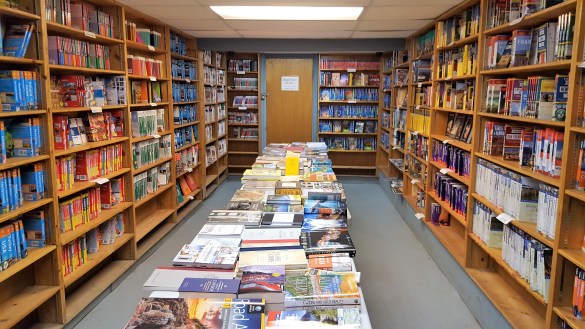
Here’s my quick virtual tour so you can see for yourself how great Unabridged is. Keep in mind that this barely scratches the surface; I only took a handful of pictures because I felt a little creepy taking any, much less any more. I suppose you’ll just have to visit to see the rest. And if you need inspiration on what to buy, you can either ask someone or browse among the several staff recommendation stickers lining the shelves.

20160501_135400

Baby Bear has so much story time ahead of him!

20160501_140946

I’d never seen such a large area devoted to classics before. A good reminder of so many books I have yet to read.

20160501_140627

20160501_140619

20160501_140900

I love anything to do with Scandinavia, so this whole wall called to me.

20160501_140411

This is just part of the travel section in the basement. Being in this room gave me even more of a travel bug than I already (constantly) have.

20160501_141124

Unabridged Bookstore has one of the largest LGBTQ book sections in the city (if not the largest). Not shown, but right by this is a huge discounted section. It had several titles I’ve been wanting to read, including newer ones that I would never expect to be on the sale shelves. 

20160501_144630

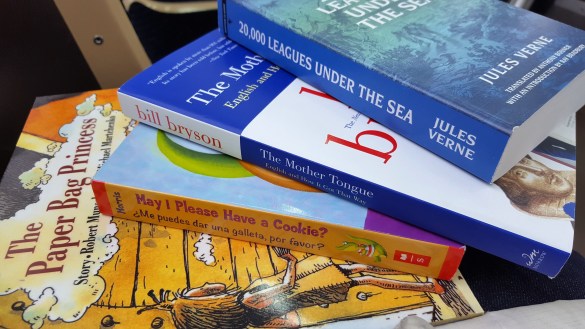
It was tough, but I narrowed down my bounty to the above selection. I see several visits in our near future.

Plan Your Visit

Location and hours

Unabridged Bookstore is located at 3251 N. Broadway Street, Chicago, IL 60657. It’s open Monday through Friday from 10:00 a.m. to 9:00 p.m. and Saturday and Sunday from 10:00 a.m. to 7:00 p.m.

Parking and transportation

There is metered street parking along Broadway and its side streets, but I’d recommend taking the Red, Brown, or Purple ‘L’ train to the Belmont stop and walking for about 10 minutes.

Stroller or carrier

Though Unabridged is large, I’d recommend using a carrier if you plan to bring your baby. It will allow you to navigate much more easily, though it’ll be harder to bend down to read the bottom shelves.

Final Word

As someone who feels pretty well versed in bookstores, I am telling you this one is exceptional. I’d make it a point to visit, and soon.

Grandma Brown’s Apple Crisp

There are two things you should know about me:

  1. I love dessert.
  2. love my family.

I am especially happy when these two things come together, like in the form of a family recipe. Today, I’d like to share one of my favorites with you: my Grandma Brown’s incredibly easy and always crowd-pleasing apple crisp. Even Papa Bear, who typically avoids baked apples, admitted he loves this one.

Grandma Brown’s Apple Crisp

This is one of my favorite desserts to make if I’m hosting an event because it’s simple, I almost always have the ingredients lying around (so my procrastination doesn’t bite me in the butt), and it tastes delicious both warm and cold.

My grandma makes it when she hosts bridge for a lot of the same reasons. Although now, she said, she and her bridge companions are trying to cut back on dessert so she doesn’t make it as often anymore. I could probably take a page from that book, but it’s simply too good.

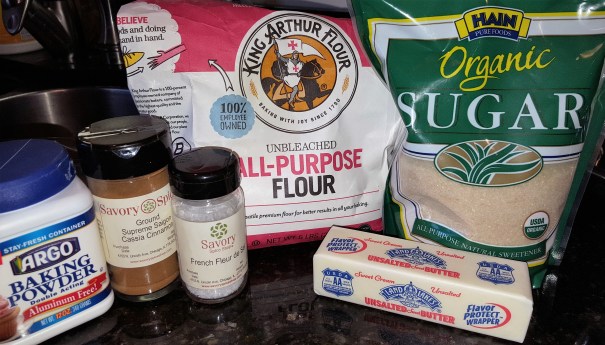
Ingredients

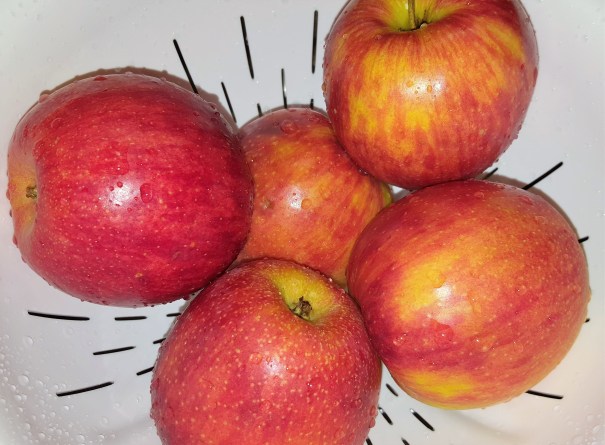
  • 5 medium tart apples, peeled and sliced (I like to use Gala apples)
  • 1 1/4 cup sugar, divided
  • 1 3/4 tsp. ground cinnamon, divided
  • 1 cup all-purpose flour
  • 1 tsp. baking powder
  • 1/2 tsp. salt
  • 1/2 cup cold butter
  • 1 cup water

20160505_152229

20160505_152322

Instructions

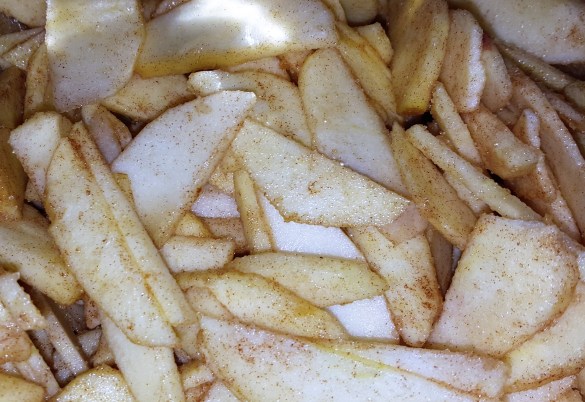
In a bowl, combine the apples, 1/4 cup sugar and 1 teaspoon cinnamon. Transfer to a greased 8-inch square baking dish (I like to use PAM Baking spray for baked goods).

20160505_153841

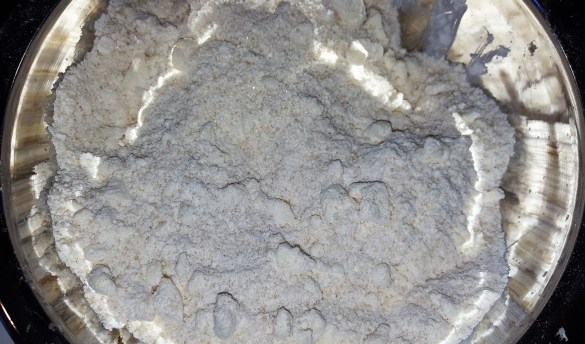
In another bowl, combine the flour, baking powder, salt, and remaining sugar. Using two knives, cut in the butter until crumbly.

20160505_154738

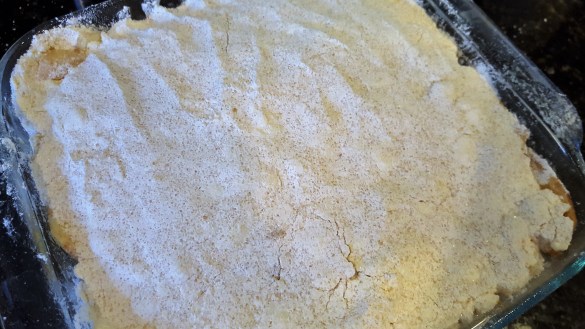
Sprinkle this mixture over the apples, pressing downh until smooth.

20160505_154945

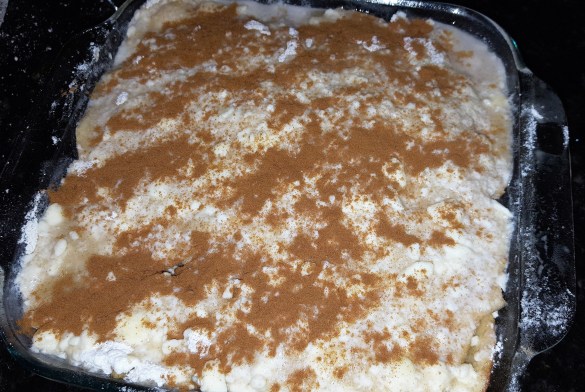
Slowly pour water over the top. Then, sprinkle with remaining cinnamon.

20160505_155125

Bake, uncovered, at 400 degrees for 40 to 45 minutes or until apples are tender and bubbly.

20160505_164524

Serve warm, then refrigerate and try it cold later. It’s scrumptious both ways. It’s also mighty tasty when served with vanilla ice cream from Oberweis.

20160505_203242

I was so eager to eat it that I didn’t stage it too well for this photo. Oh well. Worth it.

Mmm mmm mmm. I’m hosting a book club this Sunday (we are reading 20,000 Leagues Under the Sea). Maybe I’ll use that as an excuse to make this again.

Thanks for this recipe, Grandma! It will be enjoyed for years to come.

Garfield Park Conservatory: A Chicago Spotlight

And now, for a lighter topic, let’s talk about one of my absolute favorite places to visit in Chicago, the Garfield Park Conservatory. First opened to the public in 1908, the Garfield Park Conservatory is one of the oldest and largest greenhouse conservatories in the U.S. (and probably the world!).

Its gorgeous, must-see campus includes two acres of public greenhouse space and 10 acres of outdoor gardens. Plus, it is free. Even if it were not, I would gladly pay 100 times over because it is so spectacular. Stepping into the warm, earthy air of the Conservatory truly makes you feel like you’ve escaped to another land.

Let me show you what I mean.

20160510_143713

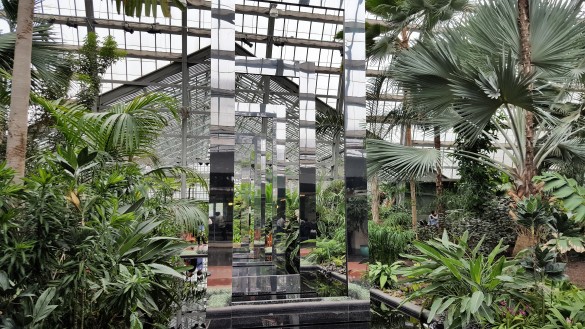
Palm House

The largest room in the Conservatory, the Palm House is home to more than 70 palms (though it feels like hundreds) in addition to many other types of plants. As you may expect, it is very tropical (read: warm). Wear layers if it’s cold outside because you will be a little toasty in your winter attire.

20160510_134849

Fern Room

Though it’s hard to choose, this is probably my favorite room in the Conservatory. Jens Jensen, the Conservatory’s designer, designed this room to allow visitors to see what Illinois looked like millions of years ago. In my humble opinion, prehistoric Chicago was stunning. I could spend hours in here (if it were not quite so warm, that is).

20160510_141216

Horticulture Hall

A nice resting spot during the day, this room apparently turns into quite the event space at night. Right now it features a chandelier that seems to be channeling Disney’s EPCOT. The futuristic Luftwerk design “is a kinetic chandelier of water and light inspired by the circular geometry of the Flower of Life–the universal symbol of creation. With each illuminated droplet, circular trays catch the water below, magnifying ripple shadows across the floor of the Conservatory’s Horticulture Hall.” With tranquil music to accompany this design, it’s very peaceful.

20160510_135215

Sugar from the Sun

This room guides visitors along four botanical environments–water, air, sun, and sugar–to help them learn how plants grow and are sustained. An educational room, it’s great for learners of all ages.

20160510_141059

Elizabeth Morse Genius Children’s Garden

This room is the most interactive, which is fitting because it is designed as a space for children. In addition to beautiful plants and ponds, a terrace overlooking the room features a huge slide (pictured below). I expect to Baby Brown Bear will be burning a lot of energy here in the not-too-distant future. For now, there is a little baby area with mats and informative and stimulating seedling artwork.

This room’s bonus is the Golden Snitch display (also pictured below) hanging from the ceiling. Upon further investigation, I discovered that they are actually rosemary and sage-filled “fireflies” as a nod to the Pagan ritual for the Winter Solstice. But a girl can dream.

20160510_140632

Desert House

This room is home to several cacti and succulents. During one recent visit, I learned that all cacti are succulents, but not all succulents are cacti. Cacti are succulents that are usually covered with spines instead of leaves. The more you know.

During my first visit, this room was actually undergoing some kind of construction. When I returned, I casually asked someone what they had done. He said, “There was a rampant snake problem they had to deal with.” He must have seen the absolute horror on my face (remember, I am extremely afraid of snakes), because he quickly added, “No, I’m totally kidding. They were just updating the room.” I still kept a close eye out for any slithering movements.

20160510_135811

Aroid House

This is a room I typically don’t spend much time in, but it’s a shame because it has a lot to offer. “Aroid” apparently “refers to a specific flower structure that is common to many houseplants,” so there are a lot of things that everyday gardeners may recognize here. My favorite features are the glass sculptures created by Dale Chihuly (as seen below). The “Persian Lily Pads” are a bright pop of color against an already vibrant green background.

20160510_135622

Show House

Before you enter the Show House, I encourage you to do a little drum roll. This room is breathtaking. Stop to soak up the dazzling array of colors before you. Breathe in the intoxicating fragrances around you. It’s honestly hard to digest so much beauty. Logistically, it’s also a good room for a break because it’s cooler than the rest.

IMG_20160316_115839


20160510_135337

Outdoor Gardens

City Garden

This outdoor garden is supposed to be both an homage to urban gardens in the structure and materials used, as well as a challenge to what we expect an urban garden to be. As you can see below, it feels like an extension of the dreamland you enter when you go to the Conservatory. It’s hard to believe you’re still in Chicago.

20160510_140149

Monet Garden

This space, which is also quite beautiful, is inspired by Monet’s gardens in Giverney, France. From all my visits, it seems to be a less explored part of the Conservatory, so make sure you actually take the time to find it.

20160510_142237

Plan Your Visit

20160510_141634

Location and hours

The Garfield Park Conservatory is located at 300 N. Central Park Avenue, Chicago, IL 60624. It is open 365 days a year from 9:00 a.m. to 5:00 p.m. every day except Wednesdays, when it stays open until 8:00 p.m.

Parking and transportation

It is easily accessible by car and even has a free parking lot next to the main entrance. I’ve never had a problem finding a spot, though I’ve never visited on a weekend. It’s also right next to the Conservatory-Central Park Drive Green Line ‘L’ stop.

Food and drink

I plan to bring a packed lunch and picnic in the gardens this summer, but in case you forget food, there’s also a gift shop that sells snacks and beverages.

Stroller or carrier?

While most of the Conservatory is handicap and stroller-friendly, the Fern Room does not have a ramp to my knowledge. Therefore I’d suggest either wearing baby or packing your carrier in your stroller so you can explore to the fullest.

Final Word

What are you waiting for? Seriously. If you have lived here all your life, you need to visit. If you only have one hour to spare, you need to visit. Stop reading this and go!

Hard is Hard

black-and-white-person-woman-girl

[Source]

Today I sat down and started writing a post about infertility, specifically what not to say to someone struggling with it.

Infertility is an emotionally loaded topic and one that is tough to unravel. Despite it being profoundly common–one in eight couples has difficulty conceiving or sustaining a pregnancy–infertility still carries a stigma. While it really sucked to have to deal with it myself, I like to share my experience to help break down the walls that make it so. Maybe I can help other infertile couples, or, almost more importantly, help their support networks feel better equipped to provide the kind of support the couple needs. 

But that is neither here nor there. As I was writing the post, something made me pause. When dealing with infertility, one of the most frustrating things people told me was that they “understood completely” what we were going through. As I was trying to describe why, it occurred to me that this frustration is not exclusive to infertility. This is something we all face in some way or another.

You know those memories that make you cringe when you recall them? Even years later, I feel nauseated when I think of some of the stupid, insensitive things I’ve said and done. I like to think I’m a good person, and that my friends and family know I would never try to make them feel bad. If we were purely logical beings, it wouldn’t be a problem because we wouldn’t take everything to heart. But we are human beings, and emotions are fortunately or unfortunately part of the package.

Humans are programmed to empathize. We thrive on forming connections to better understand, relate to, and support each other. But empathy is tricky. Unless we’ve experienced exactly what someone else is going through, we’d often be better off trying to show sympathy, and showing compassion for that person’s struggle instead of trying to relate to it our own.

In the case of infertility, I didn’t want people telling me that they understood because it took them “four whole months” to conceive. I also didn’t want people telling me that they understood but that we were lucky because it took them “much longer.” Either one seemed to downplay the pain I was feeling. I just wanted to wallow in a little self-pity and experience my struggle for what it was to me. I wanted someone to say they were there for me and that it sucked. That it must be hard for me. That self-pity may not have been healthy, but it was important that my emotions and feelings were validated for what they were.

Basically, I didn’t want my difficulty being compared on some kind of scale to what someone else had experienced.

Just by nature, when we empathize, we compare. We relate what we are hearing to what we know. Don’t get me wrong, we need empathy. Many of us have experienced similar things and it does feel good to talk about them. Therapeutic even. But here’s what I’ve come to realize:

Hard isn’t relative. Hard is hard.

Just because what we struggle with is different and may carry different consequences doesn’t mean one thing is easier than the other. Even when dealing with my own challenges, there is no need to belittle my current feelings because something I dealt with in the past was “harder.” It was hard then and it is hard now. This is true for anything: loss, illness, relationship struggles, weight gain, weight loss, trying to quit a bad habit, etc.; the list goes on and on. It doesn’t matter, and that’s the most eye-opening part of this realization for me.

Sometimes bad news is awkward to hear. We often don’t know what to say or how to respond, so we stammer out the first thing that pops into mind. We mean well, of course, but a lot of times whatever we say is just not helpful. In a lot of ways we’re automatically programmed to find common ground when instead we should accept that our problems aren’t relative to each other. They are problems and they are hard. Period.

The idea of giving ourselves space to feel what we feel is freeing. It’s important to know that when someone does compare your hard situation to one of theirs, they are most likely trying to be helpful. We’re all just trying to relate to each other, so there’s no point in harboring resentment. It doesn’t matter if what you are going through seems to you to be miles ahead of where they are; hard is hard.

Similarly, we should cut ourselves some slack when feeling guilty because we can’t relate to someone else’s challenge. It’s okay to sympathize and not quite understand. You don’t need to apologize for your life’s challenges or lack thereof. At some point, you’ve surely faced some kind of problem. It doesn’t matter to what degree we experience pain or sorrow; hard is hard. We don’t have to live the same lives to support and acknowledge each other.

Most of the time, no matter the struggle, we’d be better off just saying, “I’m so sorry you’re going through that. I am here for you.” Accepting and practicing this would probably make all of our relationships richer.

From now on, I pledge to do my best to put this revelation into practice. When my friends and family are struggling, I want to be there for them in a supportive way and will try not unintentionally diminish or undermine their feelings by comparing my struggles to theirs, even if I’m just trying to connect with them. Instead, I will try to be better at lending a sympathetic ear and acknowledging their struggle at face value, without figuring out how it fits in my own life’s spectrum of difficult experiences.

Let’s all embrace that life can be hard, no matter what “hard” means to you. We’re all just trying to figure out what it all means anyway. There’s no sense in making in making that harder.


Food Chain Magnate: A Board Game Review

Burgers, pizza, beer, pop (cheers, Midwesterners), and lemonade. As an American food enthusiast, what’s not to like?

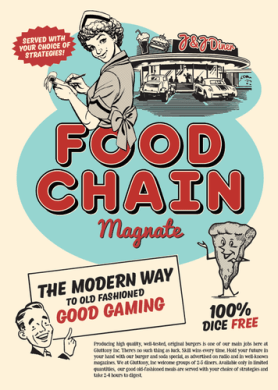
food chain

[Source]

Food Chain Magnate (FCM) is a relatively new game, published in 2015. This is the first Splotter Spellen game I’ve played, and since the company has such a reputation for quality games, I was curious to learn more. Amazingly, especially given their success, designers Jeroen Doumen and Joris Wiersinga don’t even design games full time; it’s their night and weekend hobby. Doumen is actually a mathematics PhD and Wiersinga designs computer games to improve elderly and rehabilitation care for SilverFit. By their powers combined, they create notoriously complicated and component-heavy games. After all, their company’s front-page says, “Splotter creates deep, complex board games for strategy enthusiasts.”

It should come as no surprise, then, that my pre-play research concluded that FCM was rather involved. While looking past all the components and (millions of) cards scattered across the table can be hard, I found it to be pleasantly simple to learn. Which is a good thing considering that we decided to learn it at midnight one day. (Note: It is not recommended to start any game at midnight when you have a baby.)

P.S. Remember our friend Tony Boydell? He recently played FCM and posted about it on his blog.

The Basics

Time: 120-240 minutes
Players:
2-5
Ages:
14+
BGG Rating:
8.4*
Baby Brown Bear Status: 
Played a friend’s copy

Food Chain Magnate transports you to the artery-clogging diner era of the 1950s. In it, you are the CEO of a fast food company trying to out-maneuver and out-sell your competitors’ chains. To do it, you must hire the right mix of employees (from kitchen trainees to regional managers) to create an unbeatable production, sales, and marketing strategy. The game’s length depends on how long your fellow food chain magnates want to compete. The show is over when the bank runs out of money and the magnate with the most money wins.

Just as I mentioned in my Dominant Species review, this post is not intended to be a complete explanation of the game. It has far too many intricacies to do that justice. Instead, I’m just here to give you an idea of how it works so you can decide if you want to learn the rest on your own.

*The top-ranked games have ratings of ~8.3/10. That means this is one of the best games according to BGG (as of this publication, it is listed at number 90).

Setup

There are quite a few components you need to sort out before you can start. They are as follows.

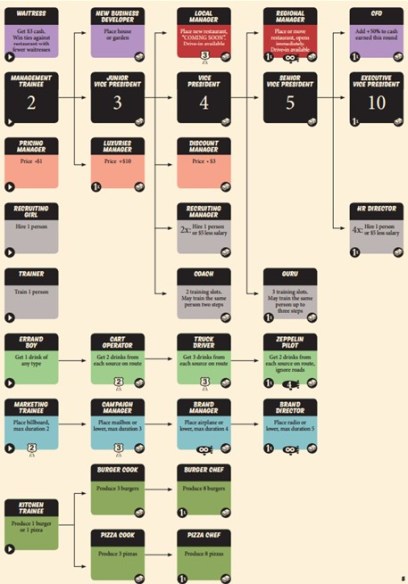
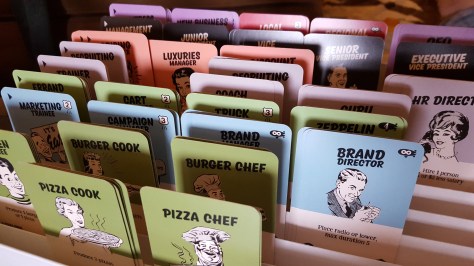
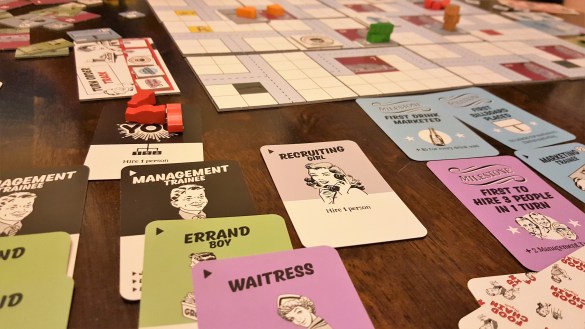
  • Employee cards. As the CEO of a company, you must hire employees across a variety of departments. As seen below, the employees on the left may be recruited by a recruiting girl or your CEO. To advance them, you must train them. As they move up the ranks, they begin to require salaries.

food chain structure

[Source]

20160430_142432

Our friend saw this genius idea on BGG. Instead of laying each card on the table (and taking up an insane amount of space), he carefully folded a piece of poster board to create just enough slots for each employee card. He even set it up so the hierarchy matched that printed on the player menu (as seen above).
  • Map tiles. The number of players determines the number of tiles needed. Each tile is then placed randomly to form your town. It initially consists of roads, drink stands, houses, and empty spaces.

20160416_231219

This map is set up for three players.
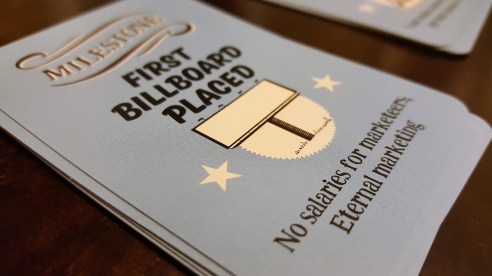
  • Milestone cards. Another part of the game that can greatly affect strategy is the milestone card. There are 18 different milestones a player can reach, such as first to place a billboard as seen below. These cards are earned any time a player fulfills a card’s requirements during a turn. If multiple players meet the same milestone during a turn, they each receive that milestone card. Most cards have benefits on them which take effect immediately.

20160416_232900

  • Food and drink pieces. Perhaps unsurprisingly, I love the little wooden figures that represent the food and drink: pizzas, burgers, lemonades, sodas, and beers. They signify different things depending on where they are placed. On marketing campaigns, they show both what is being advertised and for how long. On a house, they show that house’s demand. In a player’s hand, they show that restaurant’s available stock.

20160416_231327

  • Bank money. Ooh, paper money. So despised by this game’s owner. The bank begins with $50 times the number of players (so $150 in this three-player example). The rest of the money goes into the box at the beginning. Players do not begin with any money.
  • Player markers and restaurants. Each player has three available restaurants. The restaurant tiles have little triangular symbols that mark their entrances. Pay attention to these as distances from the restaurant start from the entrance. To begin, players randomly choose player markers to determine turn order. Beginning with the last player in this turn order, each player chooses an empty square to place his starting restaurant. Restaurant entrances must touch a road and no two restaurants can be placed on the same tile.
  • Bank reserve cards. Each player receives three bank reserve cards ($100, $200, and $300). After all restaurants are placed, each player chooses one of the three cards and puts it face down next to the bank. These cards are not unveiled until later. They indicate how much money will be added to the bank once the initial stockpile runs out. Since the game ends when the bank’s money does, this means players do not know at the beginning of the game how long it will end up being. This makes strategy difficult to determine. For example, in a short game you may want to focus on producing and selling food as quickly as possible, whereas in a longer game you may want to focus on building a larger corporate structure.

Alright! The map is out, the restaurants are placed, and players are ready to start swaying the feeble minds of the town’s citizens.

Turn summary

Okay, here’s where the going gets tough. Here’s a very simplified overview (if you can believe it).

Restructure

This is when you secretly decide which employees you want to use during the turn. You are only able to use as many employees as you have open slots (the CEO, for example, has three open slots). This number may grow depending on who you hire and put to work. Everyone who is not working during a turn is on PTO (“at the beach”). During the first round, all players will only be able to use their CEOs.

20160417_012416

Mid-play corporate structure. I really took advantage of the extra spots that came with the junior VPs and management trainees. Those waitresses really came in handy, too, not only because they earn you money but they also help you win business.

Phase 1: Turn order 

The player with the most open slots in his corporate structure chooses his position in the turn order track, followed by the player with the second most open slots, etc. If there is a tie, the player who went ahead in turn order last time chooses first.

Phase 2: Business

This is where you take care of your operations.

60804245

I’d use this meme a million times if I could.
[Source]
  1. Recruit new employees based on the number of recruit actions you have (the CEO always has one).
  2. Train (or upgrade) employees based on the number of train actions you have (the trainer trains one, for example). The person being trained must be “on the beach.” Think of it as “away at a conference.”
  3. Initiate marketing campaign based on which marketing employee is working. As a professional marketer, the overly simplistic view of marketing is somewhat insulting, but it’s supposed to be the 1950s, I guess. This marketer will be away for as long as the campaign lasts, so pay special attention to the type of campaign, placement, duration, and good you choose.
  4. Get food and drinks based on which buyers and kitchen staff you have working.
  5. Place a new house or garden if you have a new business developer working.
  6. Place or move restaurants if you have a local manager or regional manager working.

Phase 3: Dinnertime

Here’s where a lot of the juicy stuff happens because it’s when you find out if your carefully crafted plans have been thwarted by that no-good businessman across the street.

During dinnertime, the town’s citizens finally consume the food and drink they’ve been craving (because of advertising; these people have no minds of their own). Starting with the lowest numbered house, players determine which restaurants have produced the food and drink in demand by that house. For example if there are two beers and one pizza on the house, the restaurant needs to be able to provide exactly two beers and one pizza in order to sell anything to that house. Unless otherwise noted (like with a milestone card), each good sold is $10.

If multiple restaurants can provide exactly what is in demand, the restaurant closest to the house wins the business (connected by a road, of course). If that is still a tie, the restaurant that has the best price (if there’s a discount manager working, it will be a little lower) or the best service (with a waitress) will win the business. If that is still a tie, the restaurant who went first in turn order will get the business. Houses with gardens pay double the unit price for each item (rich snobs!). I haven’t even covered everything here and yet you can already see how complicated it can become!

The first time the bank runs out of money, the reserve cards that were put aside in the beginning of the game are shuffled and revealed. The tallied number shown on the cards is how much money is added to the bank. The second time the bank runs out of money is when the game ends (but not before finishing up the payday phase and making sure all employees are paid for the work they do). Believe it or not, a tie goes to the person who went first in the most recent turn order.

20160417_001331

Mid-play shot. Here you can see the goods I produced this round (three sodas), my corporate structure (I loved those management trainees!), and my milestone cards. 

Phase 4: Payday 

First, players must decide if they want to fire anyone (except for marketers who are out in the field). Second, they must then pay all employees who require a salary, including marketers in the field. Each salaried employee earns $5 during this phase.

Phase 5: Marketing campaigns

This is where those advertisements persuade people to want whatever it is you advertised to them. Starting with the lowest numbered campaign (as opposed to house), players place the little food demand tokens on the houses that are within each campaign’s reach. Houses can only have three demand tokens on them and houses with gardens can have five. Therefore some houses may be full by the time a higher numbered campaign takes effect, rendering it (and your strategy) useless.

Here are some examples of houses and the goods they desire. On the left, house five wants exactly two sodas. Billboard marketing campaign 13 is active and eternally promotes one soda at the end of each round. On the right, houses 15 and 16 want exactly one burger and one lemonade. There’s an active burger mailbox marketing campaign that will last two more rounds. 

Phase 6: Clean up

During this phase, players must discard leftover food or drinks (unless they have a milestone that allows them to keep it), all employees go back into their hand, restaurants that are “coming soon” flip over to “welcome,” and milestones are earned and flipped over to signify that they are no longer available. Then the game repeats from phase one.

My Thoughts

Cons

  • Paper money. I don’t care about this as much as some people (cough, Nick), but I’ll admit paper money is a little annoying to handle. However, when trying to think of an alternative that would fit the theme, I keep coming up short. It’s a theme-appropriate kitschy detail.
  • Unforgiving with mistakes. This, like many other strategy games, I suppose, is a game where it hard to visualize all that will occur each round. There are a lot of variables that may not play out like you expect, and it’s easy to miscalculate your and your opponents’ moves. Altogether, this makes it pretty unforgiving when you make a mistake. Even if your mistake occurs early in the game, it can be nearly impossible for you to ever bounce back.
  • Loser disengagement. Because it can be so hard to bounce back, it’s easy for the loser(s) to become disengaged. The first time I played, another player and I were neck and neck until the end, making it very interesting for us. The third player was unable to catch up and proceeded to become fairly disinterested. The second time I played, I was that third player and started to tune out once I realized I had a snowball’s chance of bouncing back. Because so much of what you do is based on your corporate structure and isn’t too combative until dinnertime, it’s easier than I’d like to only pay attention to your own board unless you’re doing well enough to be a contender.

Pros

  • Graphics. I absolutely love the retro, ’50s-themed artwork. It’s simple but provides a nice flavor for the game.
  • Theme. It’s possible I love the graphics so much because I think the theme is so fresh. Who knew that it’d take a couple of Dutchmen to create such an interesting Americana game?
  • Variable length. The fact that every player has a hand in determining the game’s length but that it’s not revealed until mid-game is very intriguing. During our first game, we decided to play a short one (especially because it was after midnight). During the second game, we didn’t talk about it at all, so I was excited when we had one of each card, meaning it would be a longer game. That excitement waned, however, when I started losing by such a wide margin.
  • Employee cards. The card drafting mechanism can be a little trite, but its execution here is new and exciting. You’re recruiting employees and deciding who works and who gets to go on vacation every single round. You are in charge of their career paths, or lack thereof. Maybe it’s because I was a cog in the corporate wheel myself, but this power went to my head and I liked it.
  • Strategy differences. Since I won the first time, I tried to see if that strategy  would work the second go around and I can tell you it definitely didn’t. While I didn’t enjoy the feeling of not being able to catch back up, I do appreciate that the game forces you to alter your strategy each play. So much changes depending on the placement of the tiles and restaurants, the length, and the other players’ strategies that you must adapt.
  • Competition. It’s quite a thrill when you can accurately visualize exactly what you need to do to win the most business in a round. It’s also thrilling when you can prevent other players from properly executing their strategies. No matter what, I looked forward to the dinnertime phase each round because it was so fun to see who would be able to pull through the most. It was also very apparent both times how meaningful the milestone cards are; the first to $100 card is especially critical to win in my opinion.

20160417_013259

What game isn’t more fun when you walk away with loads of cash?

In short

Since I won’t spend my time and energy reviewing a game I hate, it should come as no surprise that I would recommend playing this game.

Simply put, it’s very different from any other I’ve played and that alone makes me like it. Food Chain Magnate is simultaneously complex and simple and demands that each play is different from the last. Yes, it can be frustrating that the rich get richer, but that’s all the more motivation to be in the rich camp. It may sound boring when people listening in hear, “I’m going to train my management trainee to become a junior vice president,” but they don’t know what that junior VP is capable of doing!

I had been told that this is a game for “serious gamers,” but I don’t think that’s necessarily true. There is a lot of planning and thinking ahead, but it’s not so complicated that you can’t figure it out while you’re playing. I think it’d be better labeled as a game for “people willing to invest time and energy into a new game.” It’s not going to take you ten minutes to explain, but it’s also not going to take you an hour. Like anything else, you just have to start. It may be hard to find, but I suggest you go check out Food Chain Magnate and give it a go.

As always, I’d love to know what you think!


How Motherhood Changed My Understanding of Time

Time is such a funny thing, isn’t it? The concept of time. It’s rather grand in theory and is the kind of thing that makes your brow furrow if you think about it too long. Time. Time. TIME. It completely loses its meaning.

What does time mean anyway? Well, until recently I never concerned myself too much with the passage of time other than to use it as a filler during small talk. “Wow, I can’t believe it’s already [insert month]. This year is going by so quickly!”

pexels-photo

[Source]

Upon conception, though, time is measured very differently, carefully even. With the help of an app, I could easily tell you at any moment exactly how many weeks (and days) pregnant I was. I’m not sure about you, but until then I had never measured my life in terms of weeks minus the occasional vacation countdown. (Baby’s progress, meanwhile, was measured in comparisons to increasingly large fruits and vegetables. Thirty weeks? Baby is the size of a butternut squash. Kind of a strange custom, really, but a lot of things about pregnancy and motherhood are strange.)

All you think about when you’re pregnant is time. “How much time do I have to finish the nursery?” “When will baby be born?” “Will we ever have time to play board games again when baby comes?”

It should prepare you for what’s to come, but it doesn’t even come close.

IMG_20150624_170738

Will the time ever come where I can see my legs again?
Pictured: Me at 37 weeks

Time stopped the day Baby Bear was born. It stopped the moment he was born.

After a 36-hour labor (an amount of time I will never forget), I was practically delirious. Luckily Papa Bear was a little more with-it than I because otherwise I’m not sure I’d remember anything from that first day. At no point did I really know what was going on around me or what time it was. All I could do was flit in and out of sleep with this incredible baby on my chest. Our visitors brought us bounties of food (including a steak and a long-awaited Portillo’s hot dog; I never seem to forget food), I know I showered at some point (the best shower I’d ever had), and I waddled to pee under the watchful eye of a nurse a handful of times. Otherwise, everything is a blur. I was exhausted and so overcome with emotion that even when we decided on his name I was not entirely alert.

In the days after his birth, I felt awestruck and more nostalgic than I’d ever been. Which was a strange feeling given that I had this new baby in my arms. I looked back and reminisced about the entire birth experience. I felt sad that each new day took us further away from that glorious moment when we first laid eyes on each other. Glorious sounds a little flamboyant, but that’s the only word I can use to describe it. Though I felt like we were still in a daze and had a hard time remembering what day or time it was, I already wanted to slow down and make sure I was truly savoring everything.

20150711_143228

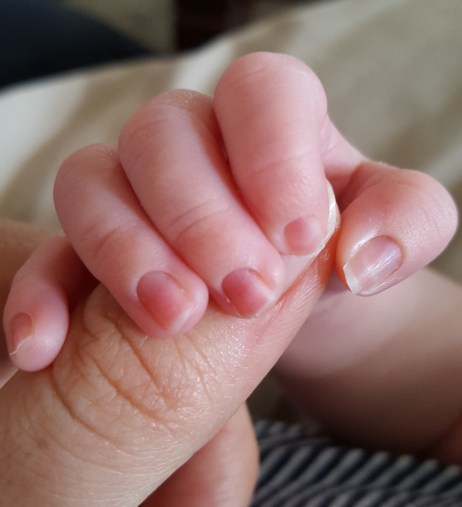
Please, never let go. (Okay, maybe let go, we’ll cut your nails, then come back.)
Pictured: Baby Brown Bear’s 6-day-old hand grasping my thumb

But then, miraculously, life continued on. Our whole lives were building to this moment and yet it passed like any other. Papa Bear and I adjusted to parenthood–this probably shouldn’t be in past tense–and have had to succumb to the now advanced pace of time.

When Baby Bear was three weeks old, he and I started attending a wonderful group for new moms (about which I will write more later). At the time, he was one of the youngest babies there. While it had taken so much effort and planning to arrive even somewhat on time, I sat there in bewilderment as the moms of older babies seemed to be so at ease with their babies and their new lives. They were relaxed and took all the things their babies did in stride while those same things still caused me so much anxiety. I admired these ‘older’ moms and hoped that some day I’d feel that way too.

I didn’t recognize it as it was happening, of course, but one day I looked around the room and realized that my eight-month-old was now one of the oldest babies there. As I tried to reassure these ‘younger’ harried and frazzled moms that life gets easier, I marveled at the fact that these babies were even born. How was it that the world didn’t stop turning when Baby Bear was born? Logically, of course, I knew this was ridiculous, but I couldn’t shake the sensation. My life monumentally changed; I no longer had a paying job, I wore yoga pants nearly constantly, I spent a lot more time with my dog, and, oh yeah, I had a baby to care for every second of my day. Was there a little tremor, at least, when he was born? Could other people feel it too?

Every single day seems to pass differently than it did before. It is simultaneously more and less structured. I no longer worry about catching the bus to catch the ‘L’ (good riddance, rush hour commute). Now, my life is measured by library times, nap times, bath times, and bed times. The weeks and months pass at an alarming speed, but that’s partly because of how much can change between each one. During one week, he peers up at me with his little toothless grin; the next, he is accidentally biting me because he hasn’t adjusted to his teeth yet.

As annoying as it can be, his life is being measured by what milestones he is hitting (or not hitting). Mine seems to be going in reverse of his. One day he will no longer fit in my arms. With each passing milestone, we are one step closer to him leaving for college. It might be a little bleak, but it’s true. Try as I might to savor each and every moment, I often catch myself scrolling through Facebook and then feeling overcome with guilt that I’m not just staring at his angelic sleeping face because it won’t always be there.

See, that’s the problem with parenthood that I wasn’t really prepared to handle: I have no idea how much time is left to enjoy each thing. It can be anything from something as innocuous as how long he’ll end up napping that day, to something more important, like how long he’ll want to keep nursing. I sometimes wish I knew. Not so I could feel better when I zone out, of course, but so I could just appreciate it even more. Mom guilt aside (that’s a whole other topic), I just want to be able to thoroughly enjoy each moment without thinking of and worrying about how fast it’s all going.

Every single parent we know has at one point told us to “enjoy it because it goes fast.” Of course I understood what they meant, but I really couldn’t wrap my head around it until it started happening to us, too. Last week, a friend said to me, “I can’t believe he’s almost one!” I stopped her, but then realized that his first birthday is only a couple of months away. It made me want to grab him, squeeze him, and never let him go.

Even now, as I type this, I have to fight the urge to let him sleep instead of waking him so I can snuggle his nine-month-old self. That’s another funny thing about parenthood: as excited as I am for him to go to sleep so I have some time to myself, I often find that I miss him only an hour or two later. In all of this blur of time, he’s become my best little buddy.

Anyway, I guess what I’m saying is that motherhood has completely morphed the way I view and experience time. It’s no longer just something to casually remark upon. It is now something to be truly cherished. Baby Bear, I never want to take you or anything you do for granted. You are my miracle.

Plus, all of this is just another reason not to worry about setting him down to fold that pile of laundry or scrub the tub. Because, really, given how fast these babies grow:

tondq

[Source]

Easy Veggie Tacos

Summer is almost upon us, and one of my all-time favorite summer dinners is veggie tacos. They are simple yet delicious and take only about 15-20 minutes including prep time. Plus, they’re healthy and light (unless you go back for thirds), so they are an easy, guilt-free option. Maybe not as much when paired when margaritas or an ice-cold cerveza, but at least it’s not doubly bad!

Vegetarian Tacos

Another great thing about this meal is that you can use whatever veggies and toppings you have available. I’d always suggest the beans to give you more substance and a protein boost, but otherwise you can play around until you find what you like best. The following is just one suggestion.

Ingredients

For the tacos

  • Extra virgin olive oil
  • 1 red onion, chopped
  • 1 jalapeño, chopped
  • 1 yellow squash, chopped
  • 1 zucchini, chopped
  • A handful of leafy greens
  • 1 can low sodium black beans, drained
  • 3/4 tsp. chili powder
  • 1/2 tsp. cumin
  • 1/8 tsp. Cajun seasoning
  • 1/2 tsp. red pepper flakes
  • Salt and pepper to taste
  • 1 package of tortillas (I like wheat tortillas)

For the toppings

  • Shredded Mexican cheese mix
  • 1 avocado, sliced
  • 1-2 green onions, sliced
  • 1 tomato, chopped
  • 1 bunch cilantro, chopped
  • Guacamole (homemade or bought)
  • Salsa (homemade or bought)

20160412_175835

20160412_175949

Instructions

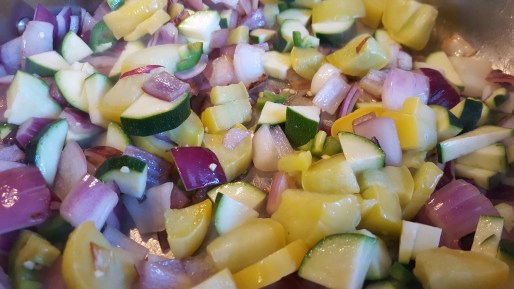
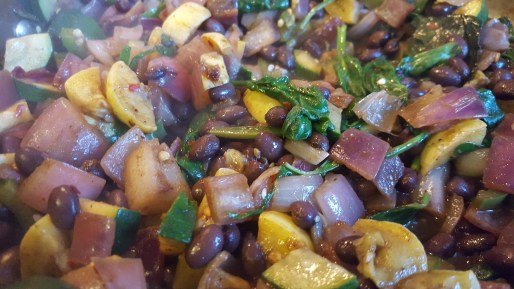
Heat a tablespoon or two of olive oil in a large saucepan over medium heat. Once the oil is hot, add onions and cook until nearly translucent.

Add the jalapeño and cook together for a minute, then add the zucchini and squash. Cook for another minute or two, or until the squash and zucchini are just slightly soft.

20160412_175737

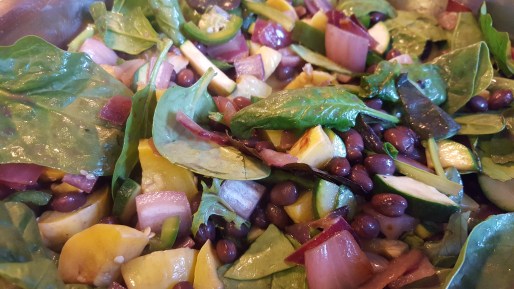
Add the can of beans. Stir and add the chili powder, cumin, Cajun seasoning, red chili flakes, and salt and pepper. Add the handful of leafy greens and mix.

20160412_180126

Cook for one to two minutes, or until leafy greens are a little wilted. Remove from heat.

20160412_180546

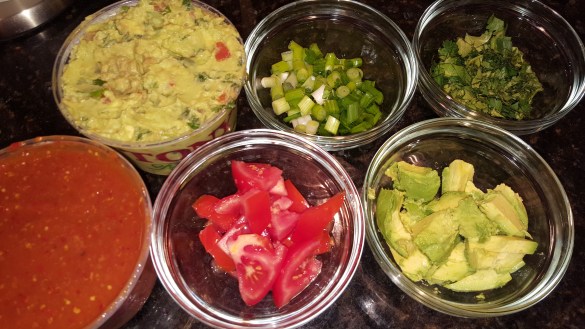
Chop up the toppings you want. I like to put them in little bowls and let people serve themselves. A taco bar, if you will.

20160412_181335

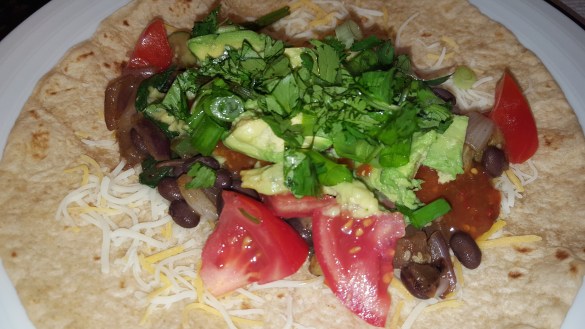
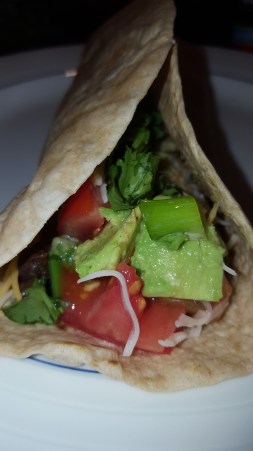
Warm tortillas in the microwave or oven, then add cheese, veggie mix, and whatever toppings you desire.

20160412_181530

20160412_181550

Enjoy! For extra fun, serve with chips, guac, and salsa and a cold beer or margarita.