Top 10 Book Club Books Part I

I could talk about books all day long. In fact, I’d love to do just that. But since it’s not exactly practical, and it would take forever to type up an entire day’s worth of discussion, a wee blog post must suffice. Well, two blog posts.

I previously mentioned that I’ve been part of several book clubs over the last decade or so. I also suggested a few of my book club dos and don’ts to help others either get started or just maintain momentum for their own clubs.

Here, I’d like to continue exploring that topic by presenting some of my favorite book club books so far. It should be noted that I have a horrible–absolutely awful–memory and yet these books have stayed with me because they sparked such rich conversations.

books

[Source]

Let me preface this list with a small clarification. While there is certainly some crossover between these books and my all-time favorites, they are not necessarily the same. Some books lend themselves to thought-provoking conversations but still may not be completely up my alley. Similarly, some of the books that I think are just mind-blowing may prove to be uninspiring to others.

“Did you like the book?” “No. I don’t even have much to say about it.” “Okay, great discussion. Have some more hummus.” On the positive side, food. On the other side, that’s not why we’re here today. Focus, Mama Bear. Focus.

While I loved all of the following books, they are my favorite specifically for discussion. My all-time favorite list will eventually come up in a different post.

Top 10 Books for Discussion: Books 10 to 6

Without further adieu, here is the first half of the list of books I’d recommend you add to your book club’s to-read list. For what it’s worth, the order is fairly insignificant. They’re all very good.

10. And the Mountains Echoed

mountains

And the Mountains Echoed by Khaled Hosseini
[Source]

This heart-wrenching novel tells the tale of three generations of one family: parents forced to make a horrifying decision, children torn apart and never fully able to recover, and a granddaughter trying to make sense of her own life. Hosseini’s beautiful storytelling ability evoked several emotions from our group and made us discuss familial sacrifice and belonging.

9. Man’s Search for Meaning

mans search.jpg

Man’s Search for Meaning by Viktor E. Frankl
[Source]

This short nonfiction work was not the easiest for some of the book club members to finish, but it was one of the most impactful for those who did. It’s only 165 pages and is broken into two sections: one about Frankl’s time as a Nazi death camp prisoner and one about the existential search to find meaning in one’s life. World War II books seem to attract book clubs (as evidenced by the next recommendation actually), but this one was incredibly different from any other I had ever read.

Unlike many other accounts of prison camps, Frankl provides more of an analysis of people’s psyches than detailing what exactly occurred in the camp. Though it’s been several years since I read it, I remember being especially affected by the idea of a prisoner finding humanity in some prison guards and finding a lack of humanity in some fellow prisoners.

Furthermore, his theory of “logotherapy,” which he details in the second half of the book, really resonated with me when I read it. The main idea behind this concept is that human beings are driven by the need to discover their individual meanings in life, that all lives have meaning, and that people are free to find this meaning (even those in horrific situations). Though I luckily cannot relate to being a prisoner, I read this when I had just finished college and was going through a bit of a quarter life crisis. This book helped me examine the meaning in my own life in terms of what was ahead. And while the other members of my book club were very mixed in terms of age and life experience, it made everyone take a look at their own lives in a similar way. Any book that can do that is worth discussing.

8. All the Light We Cannot See 

all the light

All the Light We Cannot See by Anthony Doerr
[Source]

Our February 2016 pick, this Pulitzer Prize winner is the most recently discussed book on the list. Another World War II book, this time fictional, it tells the story of two young people trying to survive the war. The first is a blind French girl who must leave her home in Nazi-occupied Paris and adjust to life in a small seaside town that is increasingly affected by the war. The second is a German orphan who is more or less coerced into joining Hitler Youth and becoming a technical specialist of sorts. They both encounter several memorable characters before their paths collide.

Even though it was a bestseller for so long, I wasn’t sure what to expect. Now I am so glad we read it. The chapters are short and the story is captivating, so the other group members and I found ourselves reading it rather quickly. That said, it was the kind of book that made me want to slow my pace a little to actually savor the prose. Put simply, this book is beautifully written. Its imagery is profound; I felt like I could run my hands along the streets of Saint-Malo and smell the salty sea air myself. There was a lot to discuss in this book, from Doerr’s writing style to the war and its effects on the people on both sides. Plus, a book that everyone ends up enjoying is a big bonus.

7. The World Without Us

world without

The World Without Us by Alan Weisman
[Source]

If you ever want to feel like a terrible human being, but in a positive, I-will-be-better kind of way, read this book.

The World Without Us is a thought experiment conducted by Weisman, the premise of which is, “What would happen to the Earth if humans suddenly didn’t exist anymore?” To find out how long it would take nature to reclaim what is rightfully hers and to see what legacy humans would leave behind (answer: so.much.plastic.), Weisman interviewed scientists and other experts and used abandoned sites such as Chernobyl, Ukraine to illustrate his findings.

Interestingly, the book doesn’t focus too much on what humans are doing wrong so much as the world we would leave behind. Even still, this book really makes you think about the impact of your actions. I’ve always had a crunchy side to me, but reading about how something as commonplace as a plastic bag will be here for thousands of years to come made me cringe, hold my baby close, and whisper to him, “Please be a positive change in this world.” While it’s unlikely humans will ever just disappear without some damage to the animals or environment around us, it’s somewhat comforting to know that if we did, it wouldn’t take too long for things to start growing over what we’ve claimed as ours.

If I had to describe this book in one word, I’d say “eye-opening.” Our discussion was rife with ideas of how to make changes in our own lives, even small ones. Any book that forces you to think outside yourself is a good one to discuss.

6. In Cold Blood
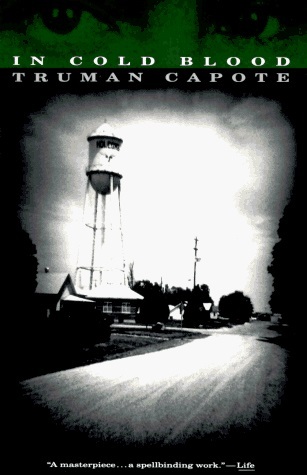
in cold blood

In Cold Blood by Truman Capote
[Source]

This was one of the first books I ever read for a book club. It’s a nonfiction crime story detailing the murders of four members of a small-town Kansas family. Capote was culturally significant in his own right, but this book is particularly interesting because it is considered by many to be the first piece of literary nonfiction. Capote himself called it a “nonfiction novel” and it reads exactly like that. It includes dialogue and narrative from multiple perspectives, and is full of suspense. These qualities made for an extremely engrossing read.

Critics have said there are a number of discrepancies from what actually occurred and what is represented in the novel, which it seems Capote repeatedly denied. This was one of the things that made our book club discussion so engaging. We talked about the prose and the overall writing style, sure, but we also had a little debate about how much we personally believed and about how much it mattered either way. Journalism ethics for the win!

To Be Continued…

Check back soon to read part two of this list where I’ll reveal my top five favorite book club books. I might even have to throw in an honorable mention section because this is so hard!

In the Meantime

What are your favorite book club books? Or your favorite books that you’re dying to discuss but haven’t had the opportunity yet? I want suggestions!


Baby Bear’s Favorite Children’s Books

Years ago, I was a member of the Mad Hatters, the Junior League of Chicago’s volunteer performance troupe. We would read, sing, dance, and act out children’s books and poems at various libraries and locations across the city.

Being part of a children’s literacy program is something else; seeing kids smile and engage with books during the great screen age of our time is quite incredible, really. As a member of that group, I reconnected with several children’s books that I had either long forgotten or never paid much notice. It also made me look forward to the day when I could read, sing, dance, and act out children’s books with my own kid. I correctly anticipated that it would be one of my favorite parts of parenting.

Within days of bringing Baby Bear home, Papa Bear and I made reading to the babe a nightly routine. When he was that young, it was much more for our own benefit since he couldn’t be bothered to stay awake during story time. Now, at nearly nine months, he is much more interested in what we are reading. Well, he’s at least interested in trying to grab and chew the books we are reading. But it’s a start.

The Short List

Here are our favorite children’s books so far.

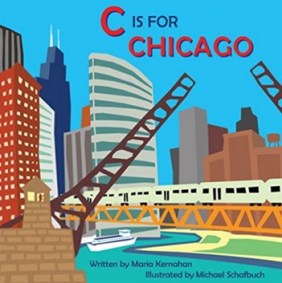
C is for Chicago 

c chicago

C is for Chicago written by Maria Kernahan and illustrated by Michael Schafbuch
[Source]

I have major hometown pride, and this book just fuels that fire. In fact, I love it so much that I will only read it to Baby Bear while he’s in his high chair because I don’t want him to tear the pages. (Note: I did see a board version available, but a smaller size would do this book an injustice.)

The illustrations are gorgeous. They are bold, bright, and really hold baby’s attention (which is no small feat). The rhymes for each letter are clever and do a wonderful job of showcasing some of my favorite things about this city. My favorite spread is, “H is for hot dogs on steamed poppy seed buns. With a garden full of toppings it’s hard to eat just one.” Imagine the artwork on that one or do one better and buy the book for yourself. I’m sure many of Chicago’s bookstores sell it, but I grabbed a copy (and a few for friends) at Enjoy, An Urban General Store.

We’re Going on a Bear Hunt

bear hunt 2

We’re Going on a Bear Hunt by Michael Rosen and Helen Oxenbury
[Source]

A classic, this was one of my favorites when I was in Mad Hatters. When kids are older, you can invite them to act it out with you. It’s especially fun when you come to the ending and have to open the door, rush up the stairs, go back downstairs, etc., because kids are great at capturing that hurried excitement.

When they’re little, kids are drawn to repetition and changes in tone and volume during the ‘noise’ pages (e.g., “Splash splosh!”). Plus, the variation between black and white and colorful illustrations provides a visually appealing contrast for all readers.

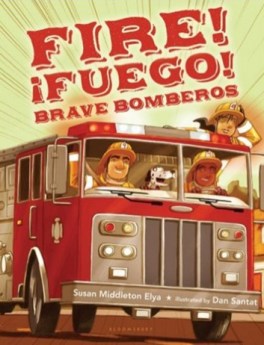
Fire! ¡Fuego! Brave Bomberos

fire fuego

Fire! ¡Fuego! Brave Bomberos written Susan Middleton Elya and illustrated by Dan Santat
[Source]

As someone who was at one time fluent in Spanish but now needs to practice a lot more than I do, I’d highly recommend this book. It creatively mixes English and Spanish to tell the story of four brave firefighters (bomberos) as they are called to extinguish a fire.

This is one of my favorite books to read aloud because each line just rolls right off the tongue. For example, “Firemen raise the ladder high. ‘I’ll go. I’ll go.’ ‘Let me try!’ ‘Hey, compadres, momentito! Let me save that poor gatito.'”

The art really complements the treatment of the text; each Spanish word is bolded and there are several callouts. As a bonus, there’s a glossary of Spanish terms at the back of the book. For non-Spanish speakers, the glossary reviews pronunciation too.

INDESTRUCTIBLES™ nursery rhyme book set

nursery rhyme

Indestructibles™ illustrated by Jonas Sickler
[Source]

These are perhaps the best books a baby can have. According to their description, “INDESTRUCTIBLES are built for the way babies ‘read’: with their hands and mouths. INDESTRUCTIBLES wont’ rip or tear and are 100% washable. They’re made for baby to hold, grab, chew, pull, and bend.” From my experience, this all true. They are made from a nontoxic, paper-like material and they can seriously take a beating. In fact, I’ve often wondered as Baby Bear is playing with these if I’m teaching him that it’s okay to treat books like chew toys, but I’ve learned that he’ll chew a book regardless. At least these are meant to be chewed.

If you’re like me and you couldn’t remember the words to these nursery rhymes (I wish I were kidding), you’re in luck because all of the words are printed on the back. Each line corresponds to a different page with its own dazzling illustration. The colors are vibrant and the images almost seem textured as the illustrator made use of many different patterns. As if all of these things weren’t great enough, each book is extremely lightweight and makes for a perfect diaper bag toy.

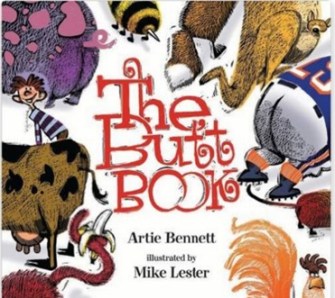
The Butt Book

butt

The Butt Book written by Artie Bennett and illustrated by Mike Lester
[Source]

Baby Bear’s cousin has given us several great books so far, including the INDESTRUCTIBLE set above, but this is my personal favorite. Very cheeky (no pun intended), this book talks all about butts, a topic that I’m sure will be endlessly entertaining to Baby Bear as he grows older.

The book starts off, “Eyes and ears are much respected, but the butt has been neglected. We hope to change that here and now. Would the butt please take a bow?” How could that not make you giggle at least a little bit? That’s what’s so great about this book: it’s delightfully funny for adults and kids alike. It’s hard to choose, but perhaps my favorite line is, “Some names for butts have foreign flair: tuchas, keister, derriere!”

Appropriately, all of the illustrations show different kinds of butts, from a mummy butt to a rhino butt to a teddy bear’s butt. I never thought I’d so thoroughly enjoy a book about butts, but I do!

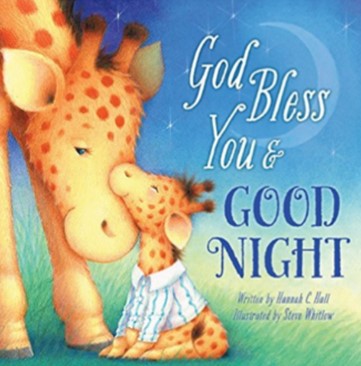
God Bless You & Good Night

god bless

God Bless You & Good Night written by Hannah C. Hall and illustrated by Steve Whitlow
[Source]

This is the last book we read before bed every night. As I’m sure is the case with many parents and Goodnight Moon, both Papa Bear and I know each of the adorable ten stanzas by heart. The book is beautifully illustrated and shows a parent (hey, it could be a mommy or daddy) animal with its baby as they go through different parts of a bedtime routine. My favorite line to read to Baby Bear is, “You’re ready now to cuddle down. There’s one last thing to do. I’ll hold you near so you can hear me whisper, ‘I love you.'” I look forward to that little snuggle every single time.

As you may expect based on the title, there are a few God references in this book. For example, “Let’s settle down and settle in and close our eyes to pray. You’ve wrestled, raced, and run and chased. ‘God, thank You for this day.'” While I’m not a big fan of overtly religious text, these don’t faze me as it’s such a sweet book overall.

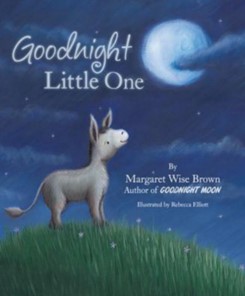
Goodnight Little One

goodnight little one

Goodnight Little One written Margaret Wise Brown and illustrated by Rebecca Elliott
[Source]

Another charming bedtime book, this one from the author of Goodnight Moon also follows different kinds of animals as they close their eyes to go to sleep. For example, “Little pig that squeals about, make no noises with your snout. No more squealing to the skies, little pig now close your eyes.”

The text is cute and the use of repetition is great for little readers, but the illustrations are by far my favorite part of this book. Each little animal looks so sleepy and cuddly, I can’t help but lull myself to sleep along with my babe.

Shop Local

You’ll notice that, with the exception of C is for Chicago, which sends you to a different local shop, each link sends you to the Book Cellar, my local bookstore. As I mentioned in my recent board game post, I am a firm believer in “shopping local” and supporting my community’s small businesses. If you don’t want to go into the store, the Book Cellar will ship directly to you. If you’d prefer to support your favorite local bookstore, I’m sure they can order these books for you if they’re not already in stock. Help the little guys out!

Your Favorites

I can’t recommend these seven books enough, but what are we missing? Comment and share your and/or your kid’s favorite books. We are always looking to grow our library.

Book Club: An Introspective

I love books. I love the feel of books, I love the smell of books, I love taste of books (kidding). I love reading books. Hell, I even love reading about books (thank goodness for Goodreads). As such, I also love talking about books. It makes sense, then, that I’d love book clubs as they are the intersection of reading and discussing.

bibliophile

[Source]

Over the last decade, I’ve been a founder and/or member of a handful of book clubs. Some have been with friends, others with strangers. Some have had wonderfully clever names (Bibliophiles Beets Battlestar Gallactica Book Club–circa the years of Dwight and Jim’s hijinks), others have been more to the point (Corpus Christi Book Club). Some have worked well, others have failed. Sometimes a successful meeting will consist of only three members. Other times, it takes a whole room of people to get the conversation going.

If you’ve ever participated in a book club, you may know just how difficult it can be to get one started in earnest or how hard it is to keep the momentum going.

Because I could talk about how much I love book clubs forever, I’ve decided to reflect on what it is that works well and, just as importantly, what doesn’t when forming and maintaining a book club.

Building That Bibliophile Base

Starting a book club is exciting. You love to read and you probably have a few friends who love to read. So why is actually making a book club happen so difficult?

keep-calm-and-join-book-club

[Source]

The dos:

  • Do start small. Invite a few people you know who love to read and expect to build your club membership over time.
  • Do add diversity. Yes, even close friends have unique perspectives to bring to a club. In my experience, though, a diverse group of ages, genders, or even just circles of friends makes for the best discussions. The love of books is a powerful relationship binder even when you have not much else in common.
  • Do schedule your first meeting. A month or two out, go ahead and start turning the wheels. Act as the first host, figure out what kinds of books people want to read, choose the first book (I suggest starting with a shorter book so as to not scare would-be members off), then just pick a date that works for people. If you have a lot of people trying to chime in, I suggest using an online scheduling tool like Doodle. As far as the location goes, if you don’t want to host in your own home, a local coffee shop (with enough seating) works well, too.
  • Do figure out who you are. Are you a genre-specific book club or will you read across genres? Fiction, non-fiction, or a mix? I’ve admittedly only belonged to the variety camp because one of my favorite things about a book club is that it encourages people to read outside their comfort zones. One member recently told me that joining our book club has made her enjoy fiction for the first time in years. She said she never would have realized she liked it had she not been in the club because she never chooses fiction for herself. What a compliment!

The don’ts:

  • Don’t be afraid to remind people. After you determine your first date, create a calendar invite (Google Calendar, Evite, etc.) to actually get it on everyone’s calendars. Even after that, ask people if they’ve started reading. Engage your members in teaser discussions to help build excitement for the meeting. Remind them of the date a few times so you don’t have a meeting of no-shows. This may sound like overkill, but trust me, it’s not.
  • Don’t come without some discussion questions. Sometimes a book is so thought-provoking that people come armed with questions or discussion topics. Other times, the conversation may be slower to start. This is totally normal. As the host, though, it’s never a bad idea to have a few ideas in your back pocket. You can easily browse the title of the book with “discussion topics,” but I’d also suggest looking at LitLovers for some thoughtful questions.
  • Don’t be too formal. A book club is supposed to be a fun hobby. No one wants to participate in one that’s rigid. Even if you don’t know people well, help foster a warm and welcoming environment and invite everyone to participate without calling on anyone. Similarly, don’t freak out if someone hasn’t finished the book. This will almost inevitably happen to you at some point too. Our book club’s rule is that we will discuss the ending, so if you come to the club, you should expect spoilers. That said, you’d be surprised how captivating a conversation can be even when only a few people have actually finished.
  • Don’t forget to choose the next host. Even if you decide to have each meeting take place at a neutral location, I suggest designating a different host for each one. In my most successful clubs, the person who hosts is responsible for choosing the next book (or, if they have no preference, opening the floor for suggestions). They will also be responsible for meeting reminders and discussion questions. Rotating hosts helps everyone feel responsibility and ownership for the group and keeps it from becoming a burden for one person.
  • Don’t forget to schedule your next meeting. Before you leave your first meeting, you should decide when you will meet next. In fact, you should determine the cadence with which you plan to meet (e.g., monthly) and, ideally, the timing (e.g., the third Sunday of each month at 3:00 p.m.). This helps people set their calendars ahead of time (knowing that some months will need to be more flexible). Regardless of what you choose, I’ve found that waiting to poll people on their availability after the meeting ends often means the next meeting will be delayed. Be respectful of the people who took the time to come and cater to their needs first. Anyone else will come if they can.

Keeping Up with the Book Club-dashians

You’ve had your first, maybe even second or third, meeting! Now what?

book club

[Source]

The dos:

  • Do encourage people to invite others. It’s a great problem to have if your book club is expanding enough that you need to break up into smaller discussions because there are too many people for one. Tell people to invite their friends, coworkers, or anyone who would be an interested and respectful addition to your club.
  • Do take advantage of social media. Facebook has been a great tool for my book club. The host posts the meeting information each month (date, time, location, and book) and tags anyone who has specifically expressed interest to make sure they see it. We also share relevant links with each other (like “20 Books You Can’t Put Down” or “The Andrew Luck Book Club“). Other clubs I’ve been in have used tools like Meetup, which is especially helpful if you want an open invitation to anyone in your area.
  • Do reflect on what works for your club. If monthly meetings become too stressful or the books you’re choosing are too long, it’s time to evaluate and change something to make the club fun. If you’ve determined that you don’t want to just read science fiction, try a new genre. Nothing you decide has to be permanent. Experiment a little until you find what works best for your group.
  • Do be flexible. Sometimes, especially over the holidays, people are too busy to meet and it is easiest and least stressful for everyone to just push back the meeting by a month. Just make sure to get the next date on the calendar as soon as you can so you don’t fall into a cycle of delays and cancellations.

The don’ts:

  • Don’t be afraid to let people go. Book club membership will wax and wane. That’s just how it goes. Sometimes people lose interest, become too busy, move, or just fall out of the reading habit. It happens and you just have to move on. It’s most likely not personal.
  • Don’t be too bummed when people flake. Similarly, sometimes you choose a book that everyone is excited about and a bunch of people RSVP yes only to have only two or three actually show up. Life sometimes gets in the way! Just remember that a conversation between two people can be equally engaging as one with seven.
  • Don’t forget to include food and drink. Remember, book clubs are social events. If you host a meeting at your home, I encourage you to do a little potluck with food and drinks (alcoholic or non). A little chitchat is fun and healthy. These people may become good friends of yours, so you’ll want to allow yourselves time to catch up, have a drink, and grab food before you dive into your book discussion.

The Gist

Remember, a book club is supposed to be FUN! They shouldn’t cause you to stress or hate reading. Instead, they should just fuel the fire that is your love of all things books. Now get out there and join an existing club or start one of your own!

I’m happy to answer any questions you have regarding my own book clubs, but I’d also love to hear your dos and don’ts in the comments.

book love

[Source]